Advisory AI for the NHS · live demonstrator · no patient data

Identify risk before harm. Act before the claim.

Last year the NHS paid £3.24 billion for clinical negligence on a record 15,236 new claims. Every pound was spent after the harm had already happened. Nightingale AI joins the incident reports, claims and published judgments the NHS already holds, so systemic risk is visible first — and a named person decides what to do, every time.

Built for NHS Trusts and ICBsNHS ResolutionDepartment of Health and Social CarePatient-safety and legal teams
SignalIncident recorded
FlaggedNightingale flags the pattern
ClaimNotified years later
Litigation£3.24bn a year
The cost · figures Parliament already knows

£3.24 billion a year, paid after the harm.

Paid out for clinical negligence, 2025/26 £3,238.5m ↑ 4.8% on 2024/25 · roughly the running cost of several large hospitals
New clinical negligence claims 15,236 ↑ 5.6% on 2024/25 · a record, and the trend is up
Claimant legal costs £622.2m on small claims, lawyers' costs now exceed the damages paid
NHS's own legal defence costs £188.4m ↑ 3.9% · spent proving what happened, after it happened
Provisioned for future liabilities£60bn+liability has quadrupled in twenty years — Public Accounts Committee, January 2026
Claims resolved without court proceedings84%the system already wants to resolve early; it lacks the tooling to see risk early
Decisions Nightingale makes on its own0every assessment carries a named human decision

The National Audit Office and the Public Accounts Committee have put clinical negligence cost on the political agenda and asked the Department of Health and Social Care for a plan to reduce patient harm and manage the cost. Nightingale AI is a concrete answer to that question.

Sources: NHS Resolution, Annual Report and Accounts 2025/26 (HC 421), Table 1, July 2026; National Audit Office, Costs of clinical negligence, October 2025; Public Accounts Committee report, January 2026.

The insight

The evidence already exists. It sits in four silos nobody joins.

01 · Incident reportsEvery patient-safety event in England

The national Learn from Patient Safety Events service records what went wrong, where, and how often.

02 · ClaimsTrust and NHS Resolution claim files

What the harm cost, how long it took to surface, and how it was resolved.

03 · Case lawPublished judgments, The National Archives

How courts have decided comparable facts: standard of care, causation, consent.

04 · Safety alertsNational alerts and regulator data

Central Alerting System notices and MHRA data that should change what a Trust watches for.

Four datasets. Four owners. Four formats. Nobody connects the incident to the claim to the judgment — so risk is only ever visible in hindsight. Nightingale is the layer that joins them.

What we built · one closed loop

Three agents clean, spot and cite. One human decides.

01 · Sieve cleans

The same incident under three reference numbers, caught in seconds.

Deterministic matching on identifiers, dates, organisation and event codes — exact, explainable rules, no model guesswork. Every flag names the fields it matched and the score it earned. Nothing is merged without a records owner confirming.

Two translucent documents merging into one
02 · Sentinel spots

The cluster is visible before the claim exists.

Incident counts are compared with the organisation's own baseline. A pattern above threshold raises a banded risk note at the level of a pathway, ward or service — a signal for governance review, never a finding about a person.

An amber cluster of spheres ringed by light among calm blue spheres
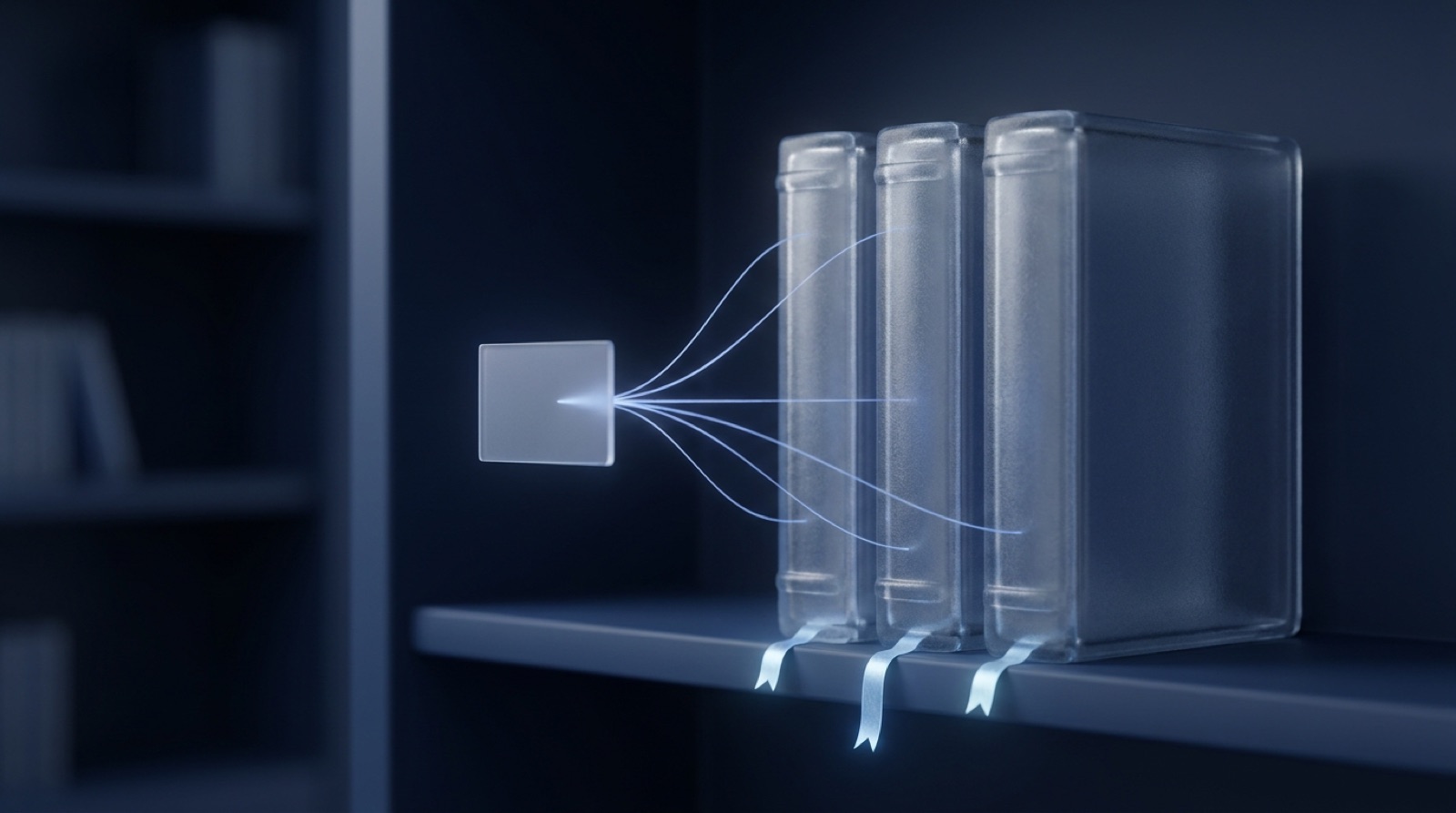
03 · Precedent cites

The comparable judgments, quoted verbatim, linked to source.

Retrieved from The National Archives' Find Case Law service: exact passages, paragraph references and links, under the Open Justice Licence. It cannot cite a case that does not exist — and when there are no close comparables, it says so.

Frosted glass volumes with threads of light linking to a floating card
04 · Review decides

A named person accepts, amends or overrides — with a written reason.

The only place a decision happens. It cannot be skipped and cannot be automated. Every decision, and the evidence pack that follows it, lands on an audit trail that nobody — including us — can edit.

A frosted glass dossier folder beside two glowing decision tokens
See it working

Claim pack to audited decision in 35 seconds.

00:00.0/ 00:35.5· narrated & captioned
01 IngestA claim pack lands, scoped to one NHS organisation.
02 CleanseSieve flags duplicate filings, naming the fields that matched.
03 AnalyseSentinel raises a risk note against the Trust's own baseline.
04 DecidePrecedent attaches judgments; a person decides; the pack is exported.
Governance is the architecture, not a feature

Advisory only. A human decides, every time.

Advisory onlyNo autonomous acts

Never determines negligence, settles a claim, starts an investigation, names a clinician or alters a care pathway.

Human in the loopStrict review state machine

Draft → assessed → under review → accepted, overridden or returned. Nothing auto-progresses; overrides always carry a written reason.

Append-only auditNothing rewritten, ever

Every load, agent run, decision and export is recorded and cannot be edited or deleted — not by reviewers, administrators or the system's makers.

Evidence-firstSources on every output

Every output carries its sources, generator and timestamps. Dossiers export as self-contained evidence packs, readable by a governance panel.

Tenant isolationOne NHS organisation per record

Every record is bound to an organisation code and classified; queries without one are blocked before they run. Built for DSPT and PSIRF.

No patient dataSynthetic claims, public case law

No real patient-level data enters the system or any training pipeline. Case law is used as metadata and short attributed quotes under the Open Justice Licence.

Most AI-for-NHS proposals bolt safety on afterwards. Here it is the product — which is what makes Nightingale deployable inside the NHS, not just demonstrable.

Who benefits

Fewer people harmed by patterns we can now see.

PatientsHarm caught earlier

Systemic risk is seen before more people are hurt by it. When harm does happen, earlier evidence means earlier explanations and earlier admissions.

CliniciansSystem patterns, not blame

Risk is framed at the level of a pathway or service — Just Culture, as PSIRF already asks. Duplicate paperwork disappears.

NHS Trusts and ICBsA governance queue ordered by risk

Fewer hours reconciling duplicate filings. Evidence packs ready for PSIRF reviews and legal meetings instead of assembled by hand.

NHS Resolution and legal teamsPrecedent in front of them from day one

Lower defence costs on claims that should settle early; stronger evidence on claims that should be defended.

The TreasuryA lever on £3.24bn a year

A direct route into an annual cost and a £60bn+ liability that the NAO and the Public Accounts Committee have both flagged.

Parliament and policymakersSovereign, accountable AI

UK-built, auditable AI in the public sector, with a named human accountable for every decision — the standard the 10 Year Health Plan asks for.

Why now

The policy, the money and the scrutiny have all arrived.

PolicyNHS 10 Year Health Plan

Analogue to digital. Treatment to prevention. Preventing harm from systemic risk is prevention. Read the plan

Funding£100m Sovereign AI R&D Procurement Scheme

The Government's route to fund UK-built AI that fixes public services. Nightingale is positioned for the NHS productivity challenge. About the scheme

ScrutinyNAO and Public Accounts Committee

Costs have tripled; liability has quadrupled. Parliament has asked the Department for a plan. A room that already knows the problem is ready for an answer.

Live today. A working demonstrator on synthetic claims and public case law — ready for one Trust to run in shadow mode.
The ask

One Trust in shadow mode. One introduction.

01One Trust, one data cycle

Connect one Trust's incident and claims feed inside its own tenant. Outputs are reviewed, nothing is actioned. We measure precision, override rate and lead time — the numbers a board can act on.

02One introduction

To NHS Resolution, the Department of Health and Social Care, or a patient-safety lead who wants to see systemic risk before it becomes a claim.

The live workspace runs on synthetic data. Ask for reviewer credentials and walk the loop yourself.